
CertiPUR-US® Foam vs. “Regular” Store-Bought Foam: What’s Healthier for Your Home?
If you’ve been shopping for a mattress, sofa, or topper, you’ve probably seen the CertiPUR-US® badge on some foams—and suspiciously low prices on others. What’s the real difference? In short: CertiPUR-US® certified foam is independently tested to meet strict standards for content, emissions, and durability, while generic “regular” foam (especially from unknown import sources) may skip those safeguards. Below, we break down the health and quality differences so you can choose what’s best for your family.
What CertiPUR-US® Actually Means
CertiPUR-US® is a voluntary certification program for flexible polyurethane foam. To earn the label, a foam sample must pass third-party lab testing and ongoing audits for:
- No ozone depleters
- No PBDEs, TDCPP or TCEP (“Tris”) flame retardants
- No added formaldehyde
- No mercury, lead, or other heavy metals
- No phthalates regulated by the Consumer Product Safety Commission
- Low VOC (Volatile Organic Compound) emissions for indoor air quality (≤ 0.5 parts per million)
These criteria focus on what’s in the foam and what off-gasses from it—key points for health-minded shoppers.
“Regular” Store-Bought Foam: Why the Variability?
“Regular” foam is a catch-all for products that aren’t certified (by CertiPUR-US® or a comparable program). Some of these foams may be perfectly fine; others can be inconsistent in chemistry and emissions, particularly when sourced from factories that don’t follow rigorous or transparent standards.
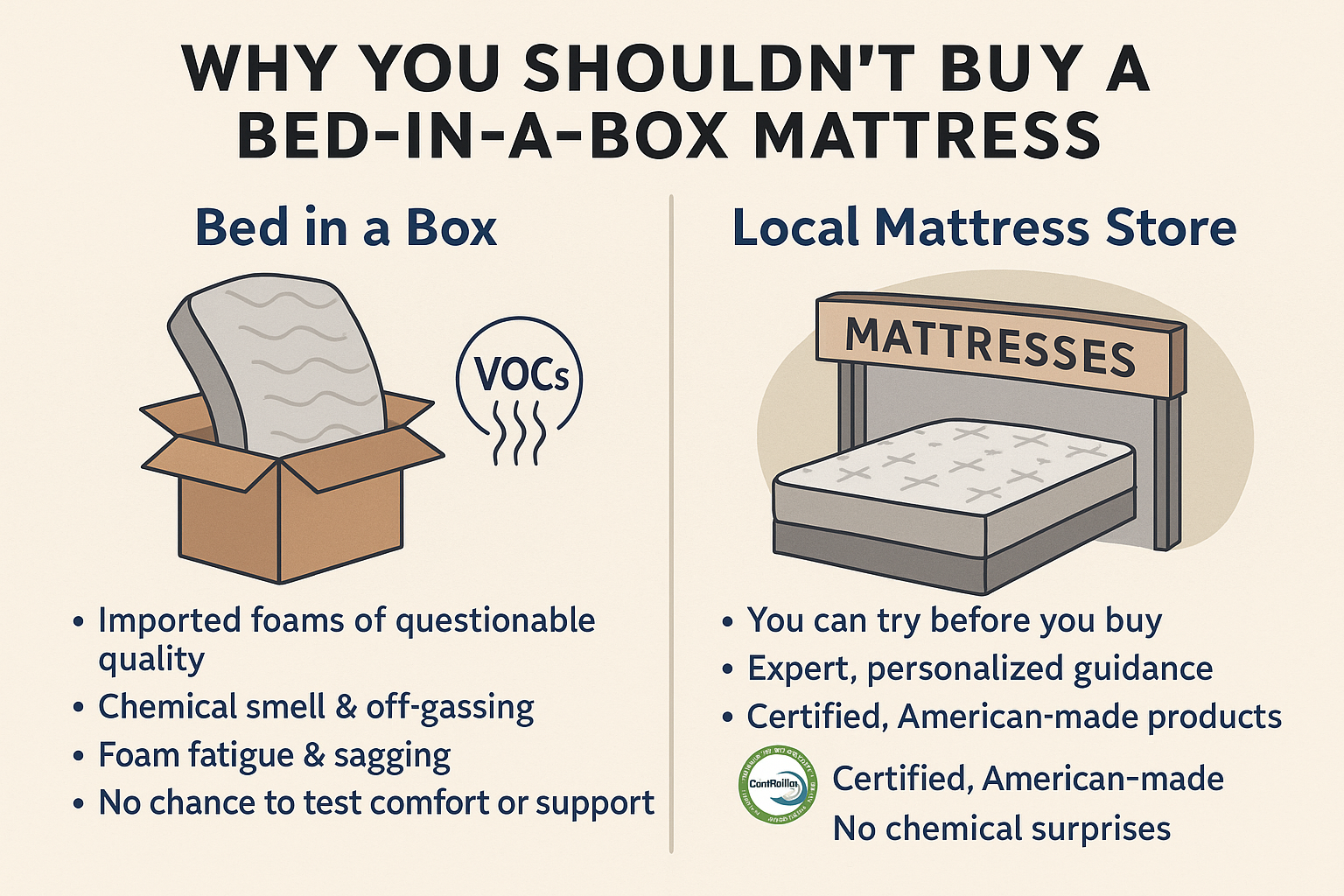
Potential concerns with non-certified, low-cost foams—often used in budget bed-in-a-box products or cut-rate furniture—include:
- Higher VOC emissions (the “new mattress smell”), which can irritate sensitive noses and eyes.
- Use of older or cheaper flame retardant chemistries you might be trying to avoid.
- Less control over residual solvents or contaminants from production.
- Inconsistent density and durability, leading to faster sagging and premature replacement.
Bottom line: without independent testing, you’re relying on the seller’s word about what’s inside.
Health Considerations: Reducing Unwanted Chemical Exposure
Many readers come to Little Birdy Reviews looking for ways to cut down on avoidable exposures in the home. While “chemical-free” foam doesn’t exist (polyurethane foam is, by definition, a petroleum-based polymer), you can prioritize safer chemistry and lower emissions:
- CertiPUR-US® foams are screened for certain flame retardants, formaldehyde, phthalates, and heavy metals.
- VOC limits help support better indoor air quality—helpful for households with babies, pets, or anyone sensitive to odors.
- Transparent audits reduce the risk of bait-and-switch formulations.
This doesn’t make certified foam “medical” or “hypoallergenic” by default—but it’s a meaningful step toward a healthier home environment compared to uncertified, bargain foams of unknown origin.
American-Made Quality vs. Cheaper Imported Foams
“Made in USA” isn’t a guarantee of perfection, but U.S. foam producers typically operate under stricter environmental, worker-safety, and consumer-protection frameworks than many low-cost overseas factories. Practical advantages you may notice:
- Tighter quality control: More consistent densities and support, fewer “soft spots.”
- Faster, fresher supply chains: Less time compressed in a box or a container, which can reduce strong initial odors.
- Better warranty support: Easier remediation if a foam fails early or arrives damaged.
- Traceability: You can verify the manufacturer and the certification listing.
By contrast, some ultra-cheap imported foams are manufactured with cost-cutting priorities first, which can show up as heavier off-gassing, premature body impressions, or thin warranties that are hard to use.
How This Plays Out in Bed-in-a-Box Mattresses
The bed-in-a-box revolution made mattresses more affordable, but not all boxes are created equal:
- Budget imports sometimes rely on lower-density foams to hit a price point. That can feel great on night one but lose support quickly.
- Extended time in a sealed box can concentrate odors; opening the wrap can release a strong chemical smell in non-certified products.
- Reputable U.S. brands using CertiPUR-US® foams typically balance comfort with density and durability, and their foams are verified for low emissions.
If you want the convenience of a boxed mattress without the gamble, look for CertiPUR-US® on every foam layer (not just the top) and confirm the foam densities (higher densities generally last longer, especially for support cores).
Quick Comparison
| Feature | CertiPUR-US® Certified Foam | “Regular” / Uncertified Foam |
|---|---|---|
| Third-party testing | Yes (content, emissions, durability) | No standard requirement |
| VOC emissions | Limited (≤ 0.5 ppm) | Varies widely; can be higher |
| Restricted substances | Screens for select FRs, formaldehyde, heavy metals, CPSC-regulated phthalates | May use older/cheaper chemistries |
| Consistency & quality | Typically more consistent | Can be inconsistent |
| Traceability | Listed/Verifiable | Often unclear |
| Typical use case | Mid-range to premium mattresses/furniture; many U.S. makers | Deep-discount furniture, some low-cost bed-in-a-box imports |
Buyer’s Checklist
- Look for the CertiPUR-US® logo and verify the brand/model on the official directory (avoid look-alike badges).
- Ask for foam densities (measured in lbs/ft³). For support cores, ~1.8 lb/ft³+ is a common durability target in polyfoams; higher is generally better.
- Check warranty length and indentation coverage.
- Read off-gassing reviews; persistent strong odors are a red flag.
- Prefer transparent brands that name their foam suppliers or certification IDs.
FAQs
Does certification change how a mattress feels?
Not directly—feel is about foam type, density, and layering. Certification addresses safety and emissions, not comfort.
Is memory foam the same as polyurethane foam?
Memory foam is a type of polyurethane foam with additives for slow-response “sink.” It can be CertiPUR-US® certified too.
Are all imported foams “toxic”?
No—many overseas manufacturers make excellent foam. The issue is verification. If it’s not independently tested or traceable, you’re taking a bigger risk.
The Little Birdy Take
If you care about indoor air quality, material transparency, and long-term durability, CertiPUR-US® certified foam—often from American manufacturers—is the safer, smarter bet. You’ll likely pay a bit more up front than the cheapest import, but you’re buying tested chemistry, predictable performance, and better support if something goes wrong.
No Comments